


How to Choose an XRF Precious Metal Analyzer?
14-08-2026
An XRF (X-ray fluorescence) precious metal analyzer identifies the elemental composition of gold, silver, platinum, palladium, and other precious-metal alloys in seconds, without damaging the sample. It is widely used in jewelry manufacturing, retail, recycling, and precious-metal inspection.
Handheld vs. Benchtop: Choosing the Right Analyzer
| Model | Type | Best for | Elements detected |
| HSM-S150/HSM-S650 | Handheld, portable | Retail counters, recycling stations, fieldwork, on-site pawn appraisal | Au, Ag, Pt, Pd, Rh |
| XRF-FM480 | Benchtop, stationary | Higher-throughput testing in a workshop, lab, or processing facility | Au, Ag, Pt, Pd, Rh |
Both are non-destructive: the sample is unaffected by testing and can still be sold, worn, or processed afterward. The handheld models suit businesses that need mobility or serve walk-in customers at a counter; the benchtop XRF-FM480 suits higher sample volumes at a fixed workstation.
Why Gold Testing Matters: Material Verification Challenges
As the value of precious metals increases, accurate material identification becomes increasingly important. Common concerns include:
● Gold alloying — Other metals can be added to change the composition and value of a gold alloy.
● Gold plating — A thin gold layer over silver, copper, brass, or other metals can make a product appear similar to solid gold.
● Different karat grades — Gold alloys can have different compositions, and elemental analysis helps verify material purity.
Conventional detection methods can be destructive or time-consuming, which is why XRF testing is widely used as a faster, non-destructive alternative.
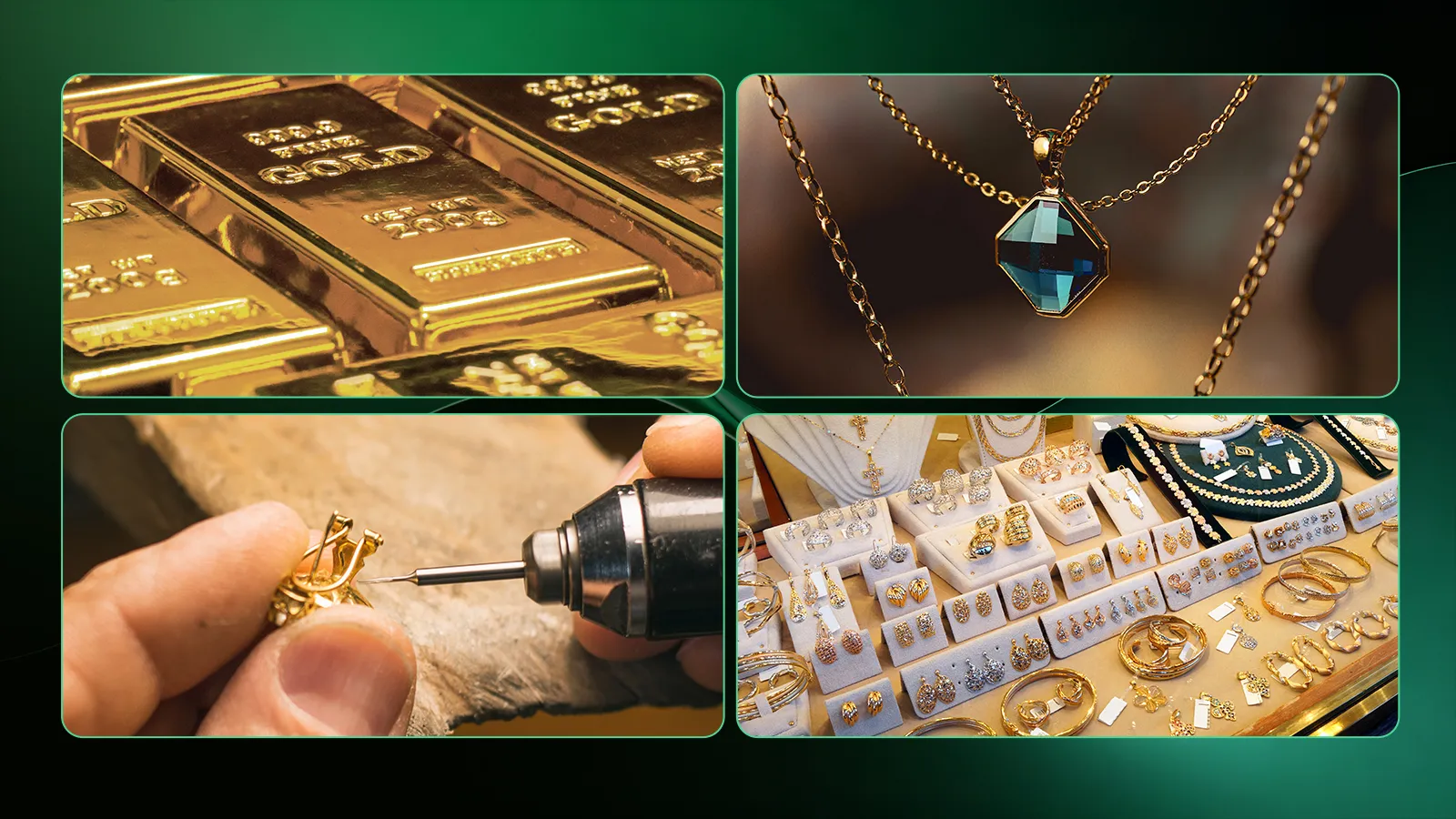
Application 1: Jewelry Production and Retail Quality Control
Across the jewelry supply chain — raw material, semi-finished parts, and the finished piece — XRF testing gives manufacturers and retailers a consistent way to verify purity at every stage:
● Tungsten/rhenium detection — Helps identify potential adulteration that conventional methods may miss.
● Plating vs. solid karat gold — Thin plated structures can be challenging for conventional XRF analysis because the measured signal can include information from both the plating and substrate. EFP-based analysis can analyze layered structures and help distinguish plating-related signals from the substrate. INSIZE XRF analyzers apply EFP-based analysis to support plated-sample testing.
● Gem-set jewelry — A vertical optical path combined with interchangeable large and small collimators allows accurate readings on the small, exposed metal points typical of gem-set pieces.
● Karat purity grading — Karat gold alloys vary in composition, and XRF testing quickly identifies the karat grade for quality control or resale pricing.
Application 2: Risk Management for Gold Pawn and Recycling Businesses
Gold pawn and recycling is high-margin but high-risk: underweight purity and adulterated items can surface regularly in real transactions. For this industry, the core challenge isn't identifying what adulteration looks like — it's the cost and speed of catching it at the counter.
Destructive testing and third-party lab verification can be too slow and expensive to use on every transaction, which is where XRF testing can help:
● Speed at the point of transaction — A 60-second test supports purity-based pricing decisions on the spot.
● Lower cost per test — Reduces the need to send samples to third-party labs for routine verification.
● Non-destructive appraisal — The item stays intact after testing.
● Easy to operate — One-button testing allows staff to run routine tests confidently.
Frequently Asked Questions
Q: What does an XRF precious metal analyzer detect?
A: It detects the elemental composition of a sample — including gold (Au), silver (Ag), platinum (Pt), palladium (Pd), and rhodium (Rh) — along with common adulterants such as tungsten and rhenium.
Q: Can XRF testing tell the difference between gold plating and solid karat gold?
A: Plated structures can be challenging because the measured signal may include contributions from both the plating and substrate. EFP-based analysis can analyze layered structures and help distinguish plating-related signals from the substrate. INSIZE XRF analyzers apply EFP-based analysis to support this type of testing.
Q: How long does an XRF gold purity test take?
A: A typical test takes about 60 seconds per sample.
Q: Should a jewelry retailer choose a handheld or benchtop XRF analyzer?
A: Handheld models (HSM-S150/S650) suit retail counters, recycling stations, and fieldwork where portability matters. The benchtop XRF-FM480 suits higher testing volumes in a fixed location such as a workshop or lab.